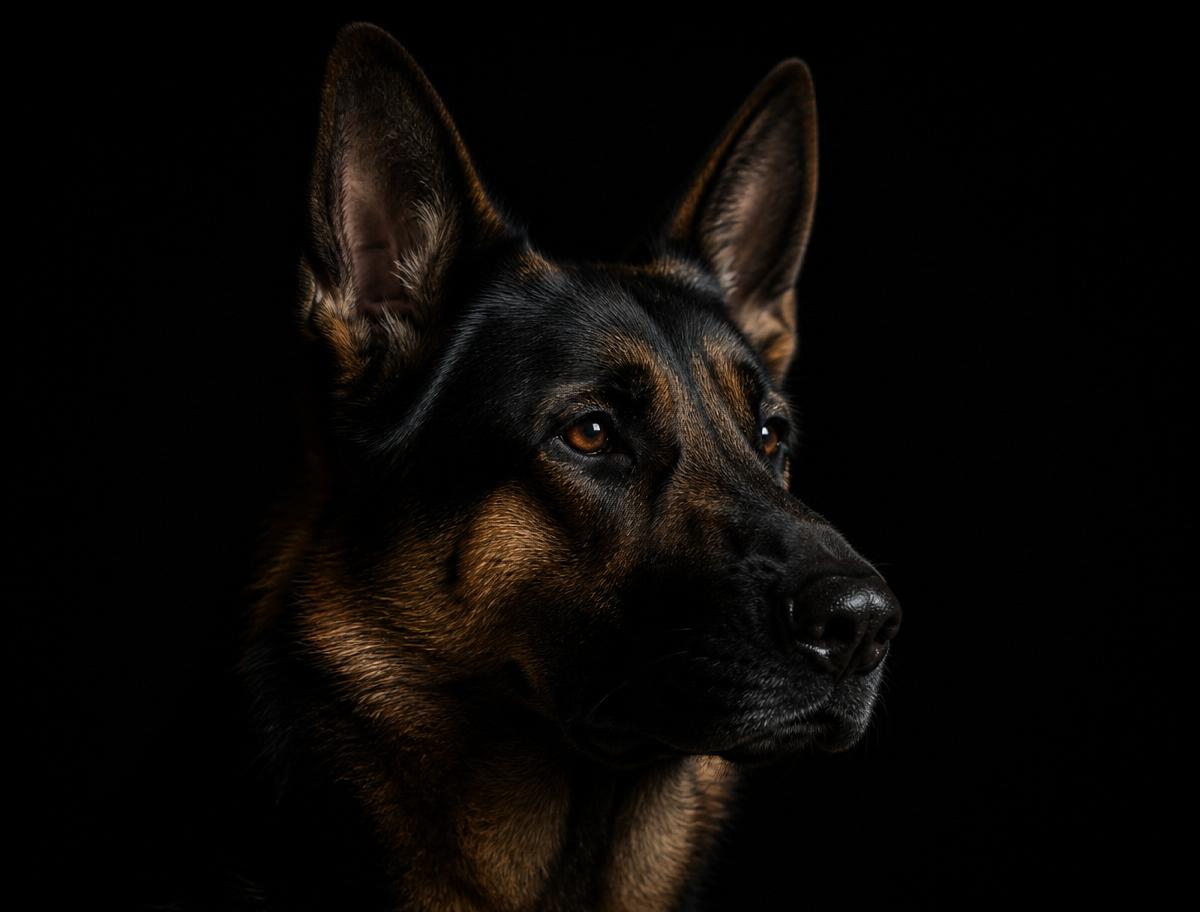
History
Max von Stephanitz registered the first German Shepherd in 1899 with a single guiding principle: utility and intelligence above all. Within two decades the breed was working in policing, military communications, guide work and search and rescue across Europe.
The twentieth century split the breed. Show lines drifted toward exaggerated angulation and softer temperament, while working lines in West Germany, the DDR and Czechoslovakia continued to be selected on trial performance and service capability. We work exclusively with the latter.
Characteristics
Working line shepherds are moderately built, straight-backed and powerful, usually sable, bi-colour or black. The double coat sheds seasonally and requires regular brushing. Compared with show lines they are more athletic, more robust and considerably more willing to work.
Temperament
The correct working German Shepherd is confident, discerning and deeply loyal. It is naturally protective without being indiscriminate, forms a strong bond with its household, and is typically reserved rather than effusive with strangers.
That combination is why the breed remains the default choice for families who want genuine deterrence with everyday liveability.
Drive and working ability
Working lines carry strong prey, hunt and defence drives in a more measured package than the Malinois. Arousal builds more slowly and settles more easily, which suits handlers who want power without constant intensity.
- Excellent tracking and area search capability
- Strong, confident grip with natural defensive maturity
- Highly biddable — fast to learn formal obedience
- Substantial physical presence and deterrent value
Training
German Shepherds respond superbly to structured, relationship-based training. They are sensitive to unfairness and will shut down under heavy-handed correction, so clarity and consistency matter more than pressure. Begin foundation work at eight weeks and protection work only once the dog is mature.
Health
Hip and elbow dysplasia remain the primary concerns, alongside degenerative myelopathy, exocrine pancreatic insufficiency and bloat risk. Buy from screened parents, keep the dog lean, feed appropriately and avoid high-impact work during growth.
Suitable owners
The working German Shepherd suits active households, family protection roles, security work and sport. It needs mental work daily and dislikes isolation. For most people wanting a serious dog that also lives well indoors, it is the sensible answer.